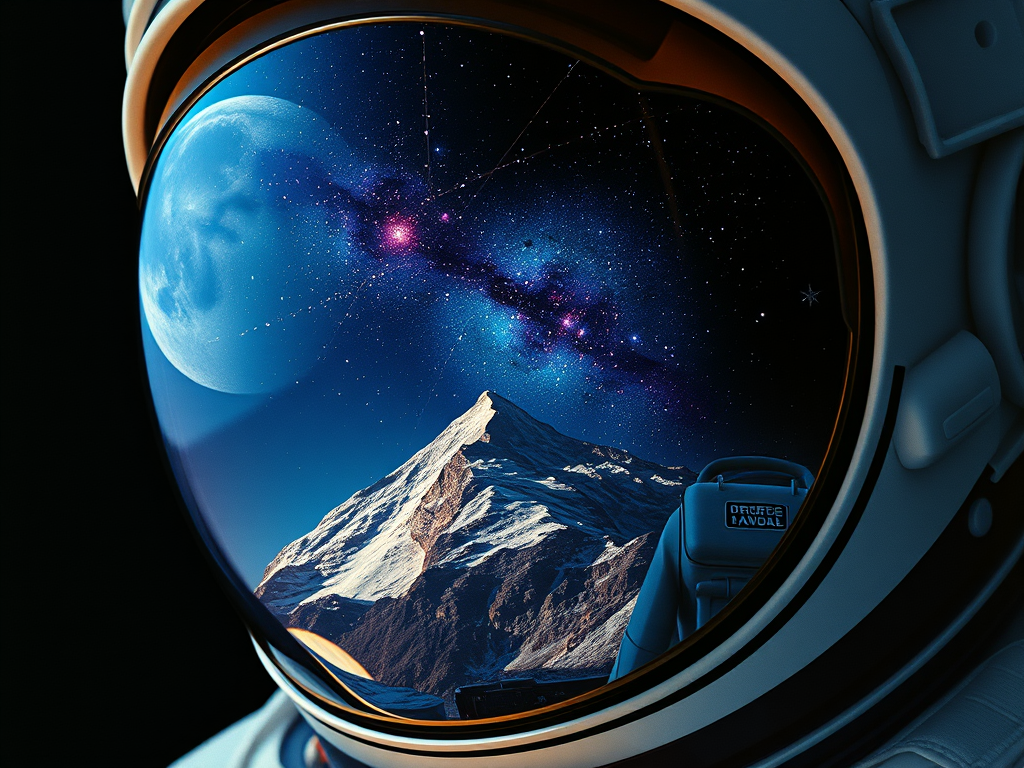
BANG!!!
The Moon was a disco ball encrusted with countless looking glass tiles. He flung His dazzling mirrors, one by one, into the infinite black where they would blaze in Orion’s belt and the tip of the Lessor Bear’s tail. His final jewel cast, the Moon was a naked, shivering satellite dutifully circling and tending to the tides of his lush, green ever-evolving sibling.
The Moon did not expect visitors any more than a forgotten wrinkled face, enduring behind a gray curtain would. When Apollo came calling, the Moon was hopeful the mission’s purpose was to attach new mirrors, but Apollo found His dusty surface too loose and scarred with craters to renovate.
There is an old saying regarding ascent and descent. The credit goes to Sir Isaac,1 but no one is ancient enough to prove it except for the Moon and He is mute on all subjects. A proverb does not require aging to axiom perfection before the wisdom it holds can be observed. And also, ignored. Generations of brave fools have climbed too high without giving gravity its due. Bucktoothed Shepard all but laughed in the face of the adage until he and Freedom were somewhere over the Soviets.
With the sweet frost of Kendal Mint Cake still on his breath, Hillary planted his flag atop the world and observed how cold, lonely and empty an ultimate achievement at all costs can be, his Sherpa2 served as witness. Apollo’s calories were freeze-dried yet packed with enough joules per square inch to power the stabbing of the national flag into the cheek of the lunar frontier. Armstrong echoed Hillary, more or less, before he snapped a photo of his witness, Buzz. And like a kitten up a tree, a cello student up a scale, the intrepid explorers wondered if they would ever get back down. Newton to the rescue!
The Moon was out early today. Half of his pale, pocked face peeked around a corner of afternoon blue like a pale child curious about the day, curious why so many chose to toil in the heat of the sun when a cool night was only an hour away. A capsule of steel cruised beneath his round chin, icy contrails drifting like white smoke from the engines The Moon, well, he paid it no mind:
"I was once a disco ball,

care not I

What shall rise

             What shall shine

                                  And what then shall fall."
Footnotes
- “What goes up must come down” attributed to Sir Isaac Newton but historically disputed. Daedalus, for instance, warned his son about the risks of flying too close to the sun years before the apple got Newton to thinking. It is widely accepted in the scientific community that Hooke and Halley were working on the gravity question around the same time the apple descended on Newton’s paranoid head. Yes, it is also widely accepted that Newton was as unreasonably suspicious and vindictive as J. Stalin and would have had all his intellectual competition arrested along with all those 17th century paperhangers. Once locked up high in the Tower none of them would ever come down from those lofty heights no matter how much the Law of Gravity was in their favor.
- Tenzing Norgay – One of the many challenges of ascending Everest starts long before you lace up the snow cleats. The foot of the mountain is reached by traversing tiger infested jungles. Sherpas are not just exotic porters, no sir.
Author Note: Lunacy or the condition of being a Lunatic was once blamed on the phases of the moon. Like so much of our vocabulary, the word has its roots in ancient Latin: Lunar i.e. the moon. According to this legend, at one point during lunation women become hysteric and people are transformed into werewolves before embarking on murderous rampages, metaphorically speaking, e.g. homo homini lupus (there is some more Latin for kids). Pink Floyd makes a reference to “keeping lunatics off the grass and on the path” in their Dark Side of the Moon Opus. There must be some lunacy influencing any decision made to climb a mountain or blast off into the void. There is something transformative about the haunting silver of a full moon, though. For more on this topic, review Holiday’s recording of “What a Little Moonlight Can Do” Brunswick 7498 1935 as 78 rpm single. 1954 album titled Billie Holiday, Clef Records (catalog number 89132×45).
 John Truelove