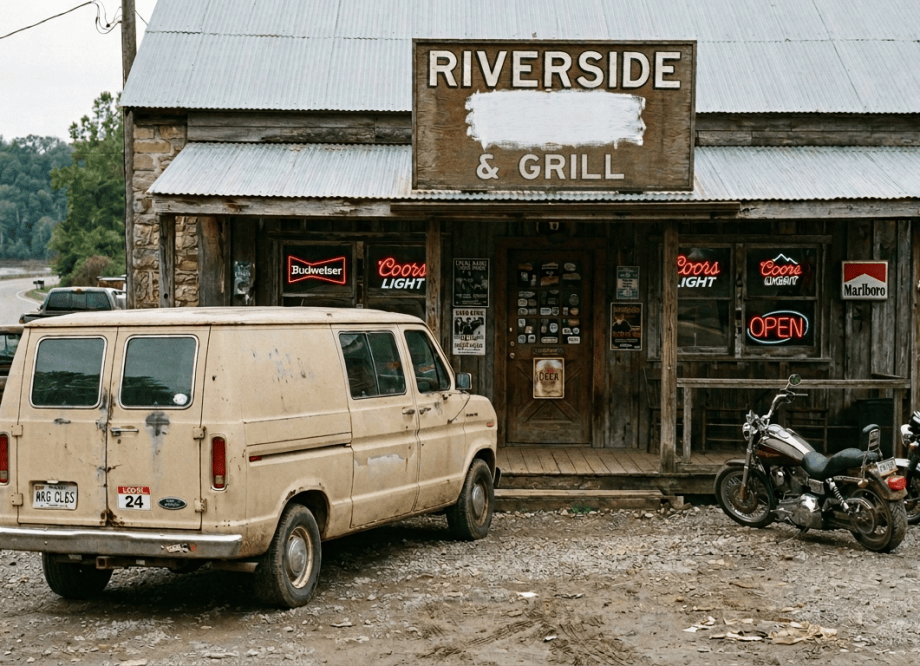
Roadhouse USA. A long history of violence. America in therapy. Juvenile pugilists.
Part III
When I was a boy, the hand that signed bills into laws or yielded the rubber VETO stamp, was none other than God Almighty. Ultimately, the majority Christian population of my State could not outlaw booze outright, but they seldom ran short on ideas of how to get between a citizen and his tipple. Therefore, it could be argued, that Jesus was in some way responsible for breaking the left leg of Doug Lemon.
The new law banning the word Bar from any establishment serving alcohol went into effect in January of that year but Wojo, the manager of Riverside Bar and Grill, took full advantage of the 30-day grace period, leaving things to the last minute, to comply. Armed with a can of white spray paint, Lemon ascended the extension ladder while Wojo secured the base, tilting his head back to oversee the job above. The term skilled laborer was never used in conjunction with the name Doug Lemon but, since his responsibilities around Riverside were seldom more complex than cleaning up spilled beer and broken glass, he was capable enough to cover the word BAR from the sign above the entrance with a thick coat of white enamel. As his instructions did not include the obfuscation of any other letters, his work produced a shingle reading: Riverside & Grill. The uneven white spot before the ampersand cemented Lemon’s jackleg reputation.
Regulars speculated about what happened next, barrooms being fecund soil for rumors, but Lemon’s plaster encased leg was evidence that something went wrong somewhere between Wojo stepping back away from the ladder to inspect the work from another perspective and Lemon’s fast descent from his perch on the uppermost rungs.
“I remember Wojo relating the details, as he remembered and embellished them, to my father. It was difficult to overhear the conversation above the latest country hit caterwauling from Riverside’s jukebox, so my recollection is based on my father’s version recanted to me on the ride home.”
“Why are you sharing this, Preston?” Dr. Isaac, asked. “I don’t mean to interrupt if you haven’t finished, but how does this story relate to the group? Give us some insight.”
The circle of faces, masks of tragedy all of them, waited for context. Dr. Issac folded his hands over the kneecap of one leg crossing the other. The ugly liver spots on the tops of his hands betrayed the age of a man whose face and hair were following a slower timeline of deterioration. My ass fidgeted for the elusive zone of comfort in the hard metal of my folding chair. Indeed, I had not finished. Insight was forthcoming
“Well, I am leading up to that, my point.” I cleared my throat, “Riverside and grill was the first time I remember experiencing violence outside of the house. Public, externalized. At that age I did not have the skills to process the violence in my own family much less what raged in the outside world.”
And that is the sort of phrase a board-certified psychologist salivates over: I did not have the skills to process, etc. It suggests the client or patient has had a breakthrough moment, bread and butter to a psychologist. After myriad grueling months of this nonsense, it’s important to demonstrate progress less you are a subjected to an extended sentence. You must tread lightly, though, peppering small breakthrough moments throughout the course of several sessions. Otherwise, it would be obvious you are trying to game the system should you demonstrate sudden enlightenment as if touched by the thumb of Lao Tzu or someone like that. Miracles make medical professionals as uncomfortable as an ass too long in metal folding chair. The APA is the higher power, the DSM their scripture. Dr. Isaac sat back and rubbed his chin thoughtfully as if to say, “Good, good. Go with that.”
“Well, it was not unusual to witness a fist fight in the Riverside parking lot or a yokel being bludgeoned with a pool cue. Violence seemed omnipresent, expected, in fact, as regular as a Regular, occupying his own barstool. And, if Violence wasn’t there it felt like someone was missing and everyone wondered if something had gone wrong and worried if that Regular would show up or not.”
My self-analysis was going too far, and I was in danger of breaking the rule of sudden elucidation. I throttled back and breathed a long, soul cleansing sigh to indicate I was finished, emotionally expended. It was now time to endure the doctor’s analysis followed by tales of woe and personal revelations from one or more of the encircled faces. How I despise people saying stupid things.
Dr. Isaac offered his thoughts on the matter, but his words were drowned out by the old sounds of Riverside & Grill bouncing around the walls of my skull. Hillbilly music, slurred advice and opinions from blue-collar drunks, the crack of pool balls, splintering glass, braggadocio. I loved it there, frankly. The random eruptions of violence didn’t bother me in the least.
In fact, it was one of the greatest thrills of my childhood when a bit of Riverside’s darkness oozed out into the regular world of my elementary school in the form of Wojo himself. Wojo, so nicknamed for his resemblance to the Polish cop on Barney Miller, albeit much shorter, was a fine fellow. He snapped open cans of Dr. Pepper in front of me as if a I was beer swilling roughneck. Sometimes he gave me 45 records intended for the Riverside jukebox. All of them hit singles but destined to go unplayed by the country music loving regulars.
Wojo was larger than life behind Riverside’s bar and so it took a moment or two to reconcile his appearance that morning in the cavernous multi-purpose room of Antioch Elementary where the whole of the student body assembled after being deposited there by the fleet of yellow buses.
Wojo stalked up and down the rows of the cafeteria tables, rolled out and unfolded for morning assembly. He was agitated, maybe half in the bag. As he paced, he shouted the nature of his business. The bartender had come to hire the services of an underaged pugilist to avenge his own young son who had been beaten black and blue the previous day during the bus ride home by another, older boy. Wojo referred to his son’s assailant as a “fucking little punk” and offered good money, flapping a twenty-dollar bill in compensation, as he continued his appeal. Wojo assured his captive audience that he would “kick this piece of shit’s ass” himself if not for laws prohibiting adults bringing harm to minors.
Hoyt Owens was the obvious choice for such work. He was a 7th grader, unusually brawny for his age and dumb as he was mean. Hoyt’s size and aura of menace did not go unnoticed by Wojo. The vengeful dad leaned in close and wrapped his arm around the boy’s shoulder to speak directly, intimately into Hoyt’s ear. While he explained the circumstances and his dilemma, Wojo pounded the table with a fist a clenched so tight it had grown white as a corpse drained of its blood. His wiry, black knuckle hairs stood in sharp contrast against his blanched skin like strokes of ink on blank letterhead. But Owens was not dumb or mean enough to accept the job, even with Andrew Jackson staring him right in the eyes and close enough to get a whiff of that crisp, new-bill smell.
It took the combined forces of principle Dietrichhausen and the 6th grade math teacher Mr. Prichard to end Wojo’s solicitation for a juvenile hitman and escort him outside. Our school’s lanky, perpetually exhausted custodian followed the struggle out the door as if he predicted the need for his mop.
Stay Tuned for Part IV

